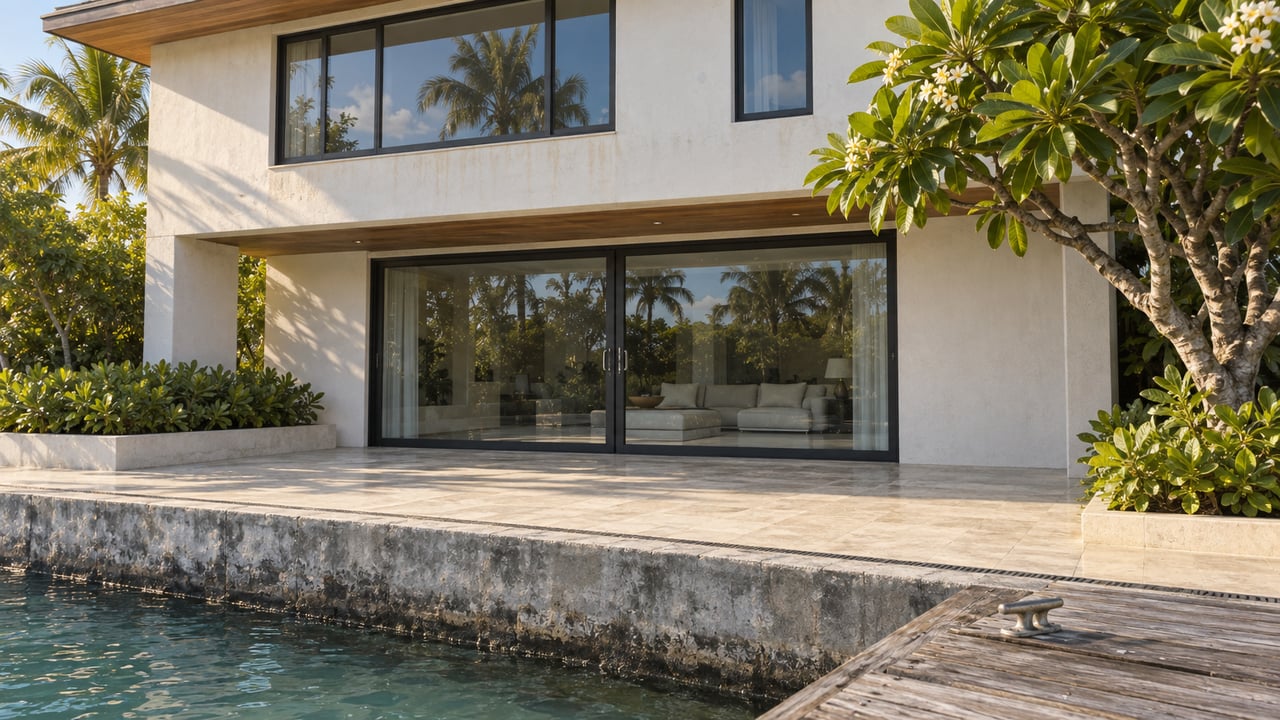
Hawaii Kai Marina-Front Home Boat Dock Ownership Explained
October 1, 2026
October 1, 2026
A marina-front listing in Hawaii Kai almost always includes a photo of a boat tied up behind the lanai. What that photo does not tell you is whether the dock in the frame is deeded to the property, licensed to it through the homeowners association, or entirely unrelated to the home you are about to buy. Two houses on the same finger of water can carry three different answers to that question, and the difference only surfaces when someone reads the title report and the HOA documents instead of the listing sheet.
Hawaii Kai is built around a body of water that makes this kind of confusion possible in the first place. The marina is privately owned, threaded with roughly 13 miles of rock-walled waterfront, and it is the only large private inland body of water on Oahu where residents can live on a canal and reach the open ocean by boat. That structure means a second layer of governance sits on top of every marina property, run by the Hawaii Kai Marina Community Association, and it is this layer, not the county or a standard condo declaration, that decides what a dock actually is.
Not every marina-front home conveys the same right to keep a boat outside it. In practice, three arrangements show up across Hawaii Kai's waterfront communities.
A deeded slip is owned outright and transfers with the title, the way a garage or a lanai would. An HOA-assigned or licensed slip is attached to a unit through the condo declaration or a separate agreement with the marina operator, and it can carry approval requirements, transfer restrictions, or a waitlist that has nothing to do with your closing date. A commercial rental slip is leased through Koko Marina Center and has no connection to home ownership at all. Slip renters there have reported waitlists running past two years, which tells you how tight the supply of water access actually is even for people who already live in the neighborhood.
The gap between these arrangements is not theoretical. Kalama Kuu, developed in 2002 by D.R. Horton as the only townhome project in Kalama Valley. Napua Point, 18 attached townhomes built in 1980 on the ocean side near the Kalanianaole Highway bridge, sits directly on the water and still has no boat dock at all, only a small beach suited to paddle craft. Both are legitimately waterfront.
Gateway Peninsula sits at the literal entrance to Hawaii Kai, 39 townhomes across six buildings built in 1972, most with a boat dock immediately outside the back patio.
Land tenure attached to a marina home is not fixed at the building's construction date. A buyer who assumes a project's tenure based on its age or its neighbors is skipping the one document that actually answers the question: the current title report.
Some of the older Hawaii Kai CP properties are two and four-unit buildings from the 1960s that carry their own tax addresses. Neighbors coordinate roofing and painting directly with each other. There is there is no reserve fund and no professional reserve study behind the seawall or the dock structure.
Seawall responsibility in the Hawaii Kai Marina is split three ways under HKMCA's own rules. Single-family dwelling owners are responsible for the wall directly in front of their home. Condominium associations, named specifically as Koko Isle Circle and Kuapa Isle in the association's regulations, are responsible for the seawalls adjacent to their condo land. The shopping centers, Koko Marina Center, Hawaii Kai Shopping Center, and Hawaii Kai Towne Center, cover the seawalls near their own commercial frontage.
A recent example shows what that commercial-side obligation looks like in practice. The Hawaii Kai Shopping Center ran a seawall repair project from January through July of this year, and boaters were asked to slow to no-wake speed passing the site for the duration. That was a multi-month project with a commercial budget behind it. A single-family owner facing the same repair in front of their own home does not have a shopping center's balance sheet to draw on, only whatever reserve or special assessment they arrange themselves.
For a buyer, that split is a due diligence item, not a footnote. Requesting seawall condition history and, where one exists, a reserve study before writing an offer tells you whether the wall protecting the property has a funding plan behind it or whether the next repair becomes the new owner's problem on day one.
HKMCA dues are separate from whatever HOA or condo fee applies to the unit itself, and for 2026 those marina dues are set at $600, due January 1 That is on top of the $500 to $1,000 monthly range typical of marina-front condo maintenance fees, which generally bundle water, sewer, trash, insurance, and exterior upkeep.
The association's own boat registration fee schedule is a useful signal of how much direct marina access is actually worth. A marina waterfront resident pays $20 a year to register a vessel. A Hawaii Kai resident without marina frontage pays $575 a year for the same registration. That is close to a thirty-fold gap between the two registration fees.
Even after closing, a dock is not something an owner can modify unilaterally. Installing or changing a boat dock on the marina side of a home requires approval from the Marina Manager under HKMCA guidelines, regardless of how long the buyer has owned the property. A buyer planning to extend a dock or add a lift should confirm feasibility before assuming it is theirs to decide.
Boat access from the marina to open water also went through a stretch of disruption recently. The state ran dredging and entrance-channel work at the Maunalua Bay public ramp from July 2025 through April 2026, with intermittent impacts to access while the ramp itself stayed open. That work sat outside the private marina, but it is a reminder that boating access in and out of Hawaii Kai is not purely a function of what happens inside the association's own waters, and a buyer should ask whether any similar public works are scheduled before assuming unrestricted access.
A few documents settle the questions a listing photo cannot answer. Ask for the recorded instrument or association policy that creates any slip right attached to the unit, and confirm in writing whether it transfers, is licensed, or is assigned by policy. Ask for the reserve study and any special assessment history, particularly for waterfront seawalls, gangways, or dredging. Confirm current HKMCA registration status and dues alongside the building's own HOA dues, since they are billed separately. If a dock modification is part of the plan, raise it with the Marina Manager before the plan depends on it.
Can a marina-front home get a dock added later if it doesn't have one now? Only with Marina Manager approval, and only where the shoreline and marina geometry allow it. A buyer who wants a dock should confirm feasibility before assuming one can be built after closing.
Are HKMCA dues the same as HOA dues? No. HKMCA's $600 annual due for 2026 covers the shared marina itself, while HOA or condo dues, commonly $500 to $1,000 a month at marina-front condos, cover the building and grounds. Budget for both separately.
Marina-front property in Hawaii Kai carries real value precisely because so few places on Oahu offer it, but the paperwork behind that value is not standardized across the neighborhood. If you are weighing a marina address and want someone to read the slip documents, the HOA reserve study, and the title history before you write an offer, Marisa Norfleet is a good place to start that conversation.
This article is general information, not legal, tax or financial advice. Consult a qualified professional about your situation.
Stay up to date on the latest real estate trends.


For personalized assistance with your real estate needs, reach out to Marisa directly. With her deep knowledge of the market and commitment to client satisfaction, she is poised to provide you with the utmost support in navigating your real estate journey.